
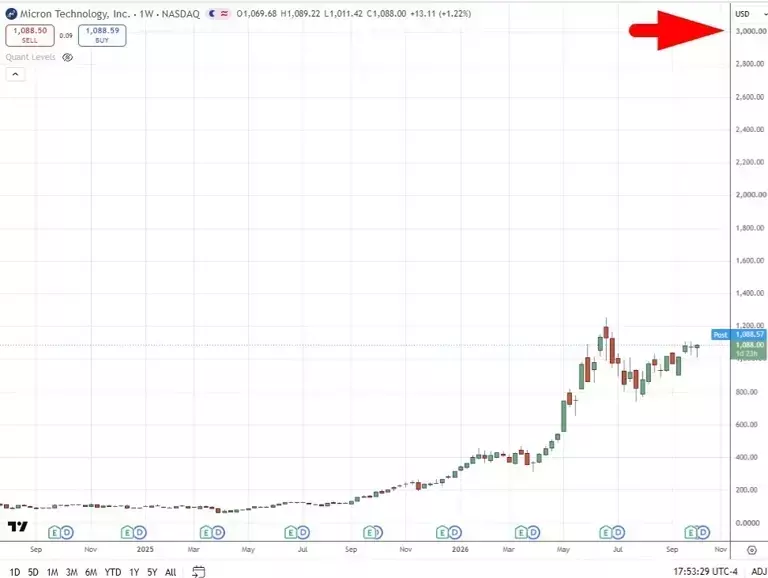
D.A. Davidson's analyst, Gil Luria, has significantly raised his price target for Micron Technology, predicting a near-tripling of its stock value. He contends that the company's current valuation, at six times earnings, fails to capture the long-term demand for AI memory solutions and an upcoming share repurchase in December. This bold projection challenges the traditional market perception of memory stocks, which typically trade at lower multiples due to their cyclical nature. Luria's forecast hinges on the idea that AI's influence has altered the industry's boom-and-bust pattern, leading to sustained growth.
The valuation debate surrounding memory stocks has intensified following D.A. Davidson's bullish outlook on Micron. While Luria suggests that AI-driven demand justifies a higher valuation, skeptics point to historical trends where memory stocks' multiples contracted at peak earnings, anticipating future downturns. The market's current modest valuation of Micron, despite a substantial 260% gain this year, reflects this historical caution. However, the anticipated December share buyback offers a more immediate and tangible support for Micron's stock, potentially bolstering its value regardless of broader market sentiment.
Micron's Growth Potential and AI-Driven Demand
D.A. Davidson's analyst, Gil Luria, has made a compelling case for Micron Technology's stock to surge, revising his price target upwards to ,000 from ,100. This ambitious projection suggests the stock could almost triple from its current level of just over ,000. Luria's analysis highlights that Micron's earnings growth has outpaced its stock price appreciation, indicating that the market has yet to fully acknowledge the company's long-term potential. He believes that investors will eventually value Micron like a growth stock, moving away from its historical classification as a cyclical company.
Luria's optimism is primarily rooted in the increasing demand for memory chips, driven by the rapid expansion of artificial intelligence. He foresees a multi-year period where memory demand will consistently exceed supply, as AI workloads become more complex and require greater memory capacity to perform efficiently. Additionally, Luria points to a significant share buyback program expected in December, which will commence once Micron is free from the repurchase limitations tied to its Chips Act government funding. This buyback is expected to reduce the number of outstanding shares, thereby boosting earnings per share. While this target significantly deviates from the consensus on Wall Street, with most analysts placing Micron's target around ,560, Luria's perspective is bolstered by Micron's strong fiscal fourth-quarter revenue of billion and an impressive guidance of .5 billion for the current quarter, both exceeding market expectations.
Challenging Historical Market Trends and Future Outlook
The core of Gil Luria's bullish thesis for Micron Technology rests on a re-evaluation of how memory stocks are traditionally valued. Historically, memory companies have been prone to boom-and-bust cycles, leading investors to assign lower multiples during periods of high earnings, anticipating an inevitable downturn. However, Luria contends that the advent of artificial intelligence has fundamentally altered this pattern, creating a sustained demand that could break the traditional cyclicality of the memory market. His revised price target implicitly suggests that the market should now treat Micron as a long-term growth play, rather than a short-term cyclical opportunity.
This re-rating, however, faces a significant challenge from historical market behavior. Investors have consistently been reluctant to pay premium valuations for memory stocks at peak earnings, adhering to the expectation of future declines. Micron's current trading multiple of approximately six times earnings, despite a remarkable 260% stock increase this year, underscores this enduring market skepticism. The target of ,000, assuming a 19-times fiscal 2027 earnings multiple, implies that Luria believes the market will eventually recognize and reward Micron's sustained growth potential driven by AI. The upcoming guidance from Micron and the prevailing memory pricing trends will be critical in determining whether the broader market embraces Luria's view and fundamentally changes its valuation approach for memory chipmakers.